"You need a CTO.” I heard that line a lot when I started building Maibel.
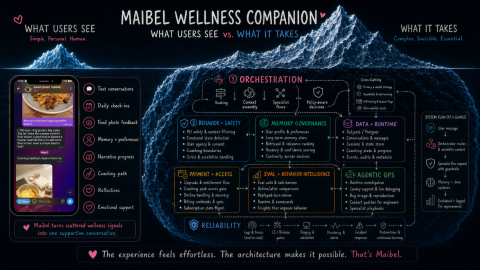
Last week at the Agentic Builders Collective, I shared the relational AI harness I designed for the first time.
I’m not an engineer by training. My background is in english literature and coaching.
A year ago, Maibel just ran its first 7-day beta as a story-driven wellness companion for women.
I'd just picked up Python and started building landing pages in HTML.
I knew how I wanted to make users feel, but thought I needed someone to translate that vision into code.
Then real women arrived.
When they churned, I learned that a response could sound caring and still be the wrong move.
I realised it wasn't a conversational defect, but a relational systems problem.
"I’m here for you” feels warm on day 2.
But on day 12, after she’s shared her fears, her routines, and the kind of support she needs - that same line can feel hollow.
She doesn't experience it as a temporal parsing error, but as a friend who'd forgotten how she wants to be cared for.
I started building Maibel as a stateful relational system instead of just a 'chatbot.'
Today, our system has dedicated layers for routing, safety, memory temporal logic, coaching strategy, missions, output constraints, and schedulers.
But the real intelligence doesn’t live in any specific model. It lives in our relational harness.
The harness holds behaviour contracts, memory rules, safety boundaries, golden pairs, tone examples, and repair patterns... all built from over 20k+ conversations across 4 live iterations.
It’s also why we hit 58.3% D30 retention for our latest iteration.
Before any model generates a single word, our system first decides the right behavioral mode: comfort, coach, remind, challenge, back off, escalate, or repair trust.
This is what generic eval frameworks miss.
Most optimise for accuracy, hallucinations, and task completion. Critical for enterprise, yes. Insufficient for deep companionship.
We optimise for felt understanding and relational consistency over time.
Building this meant poring over thousands of conversations, creating edge cases, testing memory expectations, and defining what rupture and repair looks like in relational AI.
Tedious, but necessary work.
Weirdly, my literature degree turned out to be surprisingly useful.
Years of analyzing sequence, subtext, expectation, and emotional arcs trained me for exactly this. 5+ years of coaching taught me to notice when support becomes pressure.
Today, our companion isn’t trapped inside any single model’s default personality. It lives in the harness.
When better models arrive, we’ll plug them in. Our relational intelligence will only get sharper.
Our harness makes the difference between an AI that sounds caring and one that actually learns how to care for her.
A year ago, I thought I needed a technical co-founder to start Maibel.
Instead, I grew into the person who could translate human care into durable system behavior.

Hi, I’m Mabel.
I’m the founder of Maibel. I write about emotional AI, women’s wellness and learning to build the things I wish existed.
More about me